Your Professional Valve Supplier
Jiangsu Tisco Equipment Co., Ltd. is a comprehensive valve company integrating manufacturing and trading. We specialize in the production of valves and the processing of stainless steel products, including ball valves, gate valves, butterfly valves, globe valves, as well as pipes, plates, profiles, and stems. In addition, copper, aluminum, titanium, and other alloy steels such as Inconel are also within our product range.
-
![API 6D Forged Steel Metal Seated Ball Valves Pipeline Valves]() API 6D Forged Steel Metal Seated Ball Valves Pipeline ValvesNominal size: 3~40(DN80~DN1000)Nominal pressure: Class150~2500(PN10~PN420)Standard: ISO 17292, ASME B16.34,API 608, API 6DBody material:A105, F304, F316, F11, F22, LF1, LF2End connection:FF, RTJ,
API 6D Forged Steel Metal Seated Ball Valves Pipeline ValvesNominal size: 3~40(DN80~DN1000)Nominal pressure: Class150~2500(PN10~PN420)Standard: ISO 17292, ASME B16.34,API 608, API 6DBody material:A105, F304, F316, F11, F22, LF1, LF2End connection:FF, RTJ, -
![Industrial Diaphragm Valve DN15–DN200]() Industrial Diaphragm Valve DN15–DN200Weir Type Diaphragm Valve – Most widely used, ideal for sanitary and throttling applicationsStraight Through Type – Lower flow resistance for full-flow conditionsMulti-Port Type – Used for mixing,
Industrial Diaphragm Valve DN15–DN200Weir Type Diaphragm Valve – Most widely used, ideal for sanitary and throttling applicationsStraight Through Type – Lower flow resistance for full-flow conditionsMulti-Port Type – Used for mixing, -
![ANSI Gate Valve]() ANSI Gate ValveProduct name: ANSI Gate Valve. Dn(nps): DN15 ~ DN1200 (1/2″ ~ 48″). Pressure: PN10 ~ PN420 (150 ~ 2500). Material: CF8, CF8M, CF3, CF3M, F304, F316, F321, S31803, S32750, 310 or as per your
ANSI Gate ValveProduct name: ANSI Gate Valve. Dn(nps): DN15 ~ DN1200 (1/2″ ~ 48″). Pressure: PN10 ~ PN420 (150 ~ 2500). Material: CF8, CF8M, CF3, CF3M, F304, F316, F321, S31803, S32750, 310 or as per your -
![Cryogenic Globe Valve]() Cryogenic Globe ValveProduct Name: Cryogenic Globe Valve. DN(NPS): DN15 ~ DN1200 (1/2″ ~ 48″). Pressure: PN10 ~ PN420 (150 ~ 2500). Material: CF8, CF8M, CF3, CF3M, F304, F316, F321, S31803, S32750, 310 or as per your
Cryogenic Globe ValveProduct Name: Cryogenic Globe Valve. DN(NPS): DN15 ~ DN1200 (1/2″ ~ 48″). Pressure: PN10 ~ PN420 (150 ~ 2500). Material: CF8, CF8M, CF3, CF3M, F304, F316, F321, S31803, S32750, 310 or as per your -
![GB Trunnion Ball Valve]() GB Trunnion Ball ValveProduct Name: GB trunnion ball valve. DN(NPS): DN15 ~ DN1200 (1/2″ ~ 48″). Pressure: PN10 ~ PN420 (150 ~ 2500). Material: CF8, CF8M, CF3, CF3M, F304, F316, F321, S31803, S32750, 310 or as your
GB Trunnion Ball ValveProduct Name: GB trunnion ball valve. DN(NPS): DN15 ~ DN1200 (1/2″ ~ 48″). Pressure: PN10 ~ PN420 (150 ~ 2500). Material: CF8, CF8M, CF3, CF3M, F304, F316, F321, S31803, S32750, 310 or as your -
![Cryogenic Butterfly Valve]() Cryogenic Butterfly ValveSize: DN50–DN1200. Pressure: PN6~PN40(Class 150~Class 300). Working temperature: -196℃~+80℃. Power: Manual, Electric, Pneumatic, Hydraulic. End Connection: Flange, Welding, Threaded. Structure:
Cryogenic Butterfly ValveSize: DN50–DN1200. Pressure: PN6~PN40(Class 150~Class 300). Working temperature: -196℃~+80℃. Power: Manual, Electric, Pneumatic, Hydraulic. End Connection: Flange, Welding, Threaded. Structure: -
![Triple Eccentric Bidirectional Dense Butterfly Valve]() Triple Eccentric Bidirectional Dense Butterfly ValveProduction Name: Triple eccentric bidirectional dense butterfly valve. Material: Stainless Steel alloy steel carbon steel or as your request. Specification: DN50 to DN1200. Pressure Class:
Triple Eccentric Bidirectional Dense Butterfly ValveProduction Name: Triple eccentric bidirectional dense butterfly valve. Material: Stainless Steel alloy steel carbon steel or as your request. Specification: DN50 to DN1200. Pressure Class: -
![Cryogenic Ball Valve]() Cryogenic Ball ValveSize: DN15–DN500. Pressure: PN16~PN100(Class 150~Class 600). Working temperature: -196℃~+80℃. Power: Manual, Electric, Pneumatic, Hydraulic. End Connection: Flange, Welding, Threaded. Structure:
Cryogenic Ball ValveSize: DN15–DN500. Pressure: PN16~PN100(Class 150~Class 600). Working temperature: -196℃~+80℃. Power: Manual, Electric, Pneumatic, Hydraulic. End Connection: Flange, Welding, Threaded. Structure: -
![ANSI Trunnion Ball Valve]() ANSI Trunnion Ball ValveProduct Name: ANSI Trunnion Ball Valve. DN(NPS): 3’~40’(DN80~DN1000). Pressure: Class150~2500(PN10~PN420). Material: WCB, WC6, WC9, LCB, LCC, C5, C12, CF8, CF8M, CF8C. Standard: ISO17292, ASME
ANSI Trunnion Ball ValveProduct Name: ANSI Trunnion Ball Valve. DN(NPS): 3’~40’(DN80~DN1000). Pressure: Class150~2500(PN10~PN420). Material: WCB, WC6, WC9, LCB, LCC, C5, C12, CF8, CF8M, CF8C. Standard: ISO17292, ASME -
![ANSI Flanged Ball Valve]() ANSI Flanged Ball ValveProduction Name: ANSI Flanged Ball Valve. Material: Stainless Steel alloy steel carbon steel or as your request. Specification: NPS ½ ~ NPS 24 (DN15 ~ DN600). Pressure Class: Class150 to 1500(ASME
ANSI Flanged Ball ValveProduction Name: ANSI Flanged Ball Valve. Material: Stainless Steel alloy steel carbon steel or as your request. Specification: NPS ½ ~ NPS 24 (DN15 ~ DN600). Pressure Class: Class150 to 1500(ASME -
![GB Flanged Ball Valve]() GB Flanged Ball ValveProduct Name: GB Flanged Ball Valve. DN(NPS): DN15 ~ DN1200 (1/2″ ~ 48″). Pressure: PN10 ~ PN420 (150 ~ 2500). Material: CF8, CF8M, CF3, CF3M, F304, F316, F321, S31803, S32750, 310 or as your
GB Flanged Ball ValveProduct Name: GB Flanged Ball Valve. DN(NPS): DN15 ~ DN1200 (1/2″ ~ 48″). Pressure: PN10 ~ PN420 (150 ~ 2500). Material: CF8, CF8M, CF3, CF3M, F304, F316, F321, S31803, S32750, 310 or as your -
![Cryogenic Check Valve]() Cryogenic Check ValveSize: DN10–DN300. Pressure: PN10~PN100(Class 150~Class 600). Working temperature: -196℃~+80℃. Power: Manual, Electric, Pneumatic, Hydraulic. End Connection: Flange, Welding, Threaded. Structure:
Cryogenic Check ValveSize: DN10–DN300. Pressure: PN10~PN100(Class 150~Class 600). Working temperature: -196℃~+80℃. Power: Manual, Electric, Pneumatic, Hydraulic. End Connection: Flange, Welding, Threaded. Structure:


A Cryogenic Globe Valve is specially designed to handle fluids at extremely low temperatures, typically below -150°C (-238°F). It operates similarly to a standard globe valve but is constructed with materials and features that ensure reliable performance in cryogenic conditions. The valve regulates the flow of cryogenic fluids such as liquid nitrogen, oxygen, or natural gas by controlling a movable disc within a spherical body to precisely adjust the flow rate.
Product Parameter (Specification)
We offer a full range of stainless steel, duplex, and alloy steel cross fittings in various sizes to meet different piping requirements.
|
Product Name |
Cryogenic Globe Valve |
|
DN(NPS) |
DN15 ~ DN1200 (1/2″ ~ 48″) |
|
Pressure |
PN10 ~ PN420 (150 ~ 2500) |
|
Material |
CF8, CF8M, CF3, CF3M, F304, F316, F321, S31803, S32750, 310 or as per your requirements |
|
Standard |
API 600, API 603, ASME B16.34, GOST, EN, DIN, JIS |
|
End connection |
RF, RTJ, FM, BW, SW |
|
Actuator |
Manual |
|
Package |
Cardboard boxes, wooden crates, pallets, or as per your requirements. |
Cryogenic Compatibility: Engineered to perform effectively at extremely low temperatures.
Specialized Materials: Made from materials that maintain integrity and flexibility in cryogenic conditions, such as low-temperature alloys.
Thermal Insulation: Designed with insulation to minimize heat transfer and prevent temperature fluctuations.
Precise Control: Offers accurate flow regulation even in extreme temperatures.

Cryogenic valves are used in several industries because of their crucial functioning. Some of the common sectors where cryogenic valves applications can be found include oil and gas, petrochemical, chemical, food processing, and air separation industries.
LNG Plants and Terminals
Liquefied Natural Gas (LNG) is transported easily by using cryogenic pipelines and
Valves
As the gasses have the risk of expanding, they need to be handled with caution.
Food and Beverage Industry
Cryogenic valves are commonly found in the food and beverages industry because they are suitable for carrying cold fluids. Also, these valves are employed in freezers.
Chemical and Petrochemical Industry
As for the chemical industry, there are several products like ethylene, liquid oxygen, and liquid nitrogen that need to be handled at extremely low temperatures. For this purpose, cryogenic valves are a perfect choice. They are also very useful in carrying LPG and other fluids.
Medical Industry
The scope of cryogenic valves in the medical industry is high – they are used for the storage of essential gasses like liquid oxygen.
What material options are available for Cryogenic Globe Valves
Stainless Steel (304/316)
Offers good low-temperature performance and corrosion resistance.
Carbon Steel
Often used with special treatments to handle cryogenic conditions.
Alloy Steel
Provides enhanced strength and durability in extremely cold temperatures.
Cryogenic-Specific Materials
Materials like nickel alloys designed specifically for cryogenic applications.
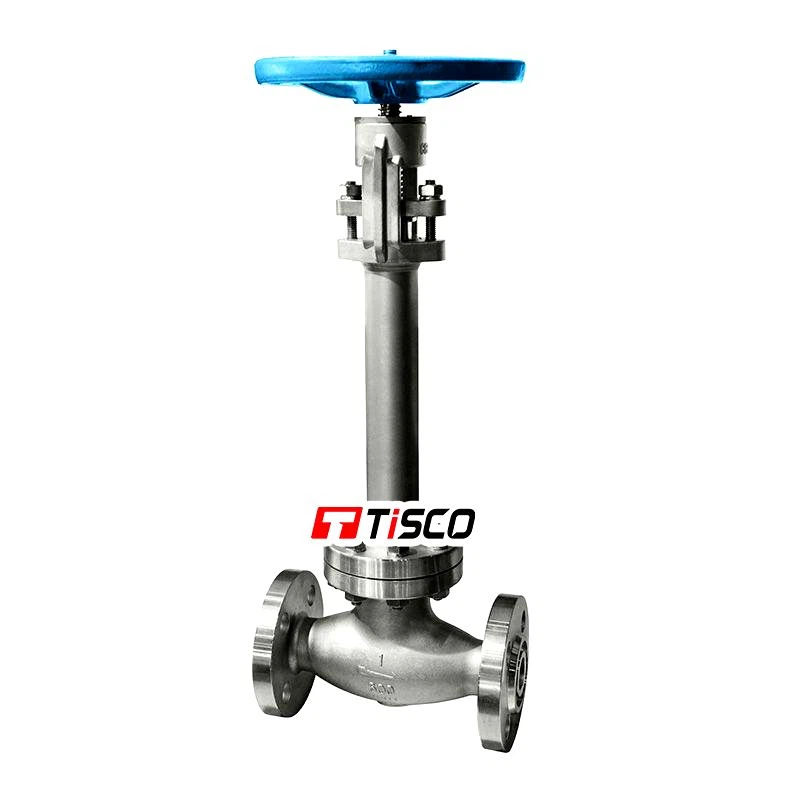
Cryogenic globe valves come in various sizes to accommodate different pipeline dimensions, typically ranging from 15 mm (1/2″) to 600 mm (24″), depending on the system’s requirements.
Working Environment and Design Requirements of Cryogenic Valves
Operating Temperature Range
Cryogenic valves are specifically designed to function in environments where temperatures can dip below -40°C. In applications such as LNG storage or liquid nitrogen pipelines, these valves often need to operate at temperatures as low as -196°C or even lower. At these cryogenic temperatures, materials used in valves experience significant shrinkage and increased brittleness. Therefore, cryogenic valve designs must account for these factors to maintain reliable function and integrity over long periods.
Sealing Requirements
Sealing is one of the most crucial aspects of cryogenic valve design. Cryogenic fluids have a high coefficient of expansion, which can cause materials to deform and seal failures if not properly addressed. Cryogenic valves must ensure a reliable seal not only at ambient temperatures but also at extremely low temperatures, where seal materials may lose their elasticity and sealing capability. Therefore, cryogenic valve sealing components must be carefully engineered to prevent leakage and ensure that the valve continues to function effectively at cryogenic temperatures.
Material Selection
Material selection plays a crucial role in the design of cryogenic valves. Standard materials such as carbon steel are not ideal for cryogenic applications due to their tendency to become brittle at low temperatures. For this reason, materials like austenitic stainless steel, cryogenic carbon steel, and alloy steels are commonly used. These materials offer better low-temperature strength and toughness, making them suitable for cryogenic environments. Additionally, cryogenic valves may incorporate specialized alloys or materials like bronze or copper-based alloys to further improve durability and performance.
Anti-Frost and Anti-Freeze Design
Cryogenic fluids can cause frost or ice formation on valve components, particularly in the packing and sealing areas. This frosting can interfere with the valve's ability to seal properly and can also cause operational failure. To mitigate this, cryogenic valves often incorporate features such as extended necks or valve stems to keep the packing and sealing components warm, thus preventing freezing. Anti-frost and anti-freeze measures are also integrated into the design, ensuring that the valve continues to operate reliably, even in the presence of extremely cold fluids.
FAQ
As one of the leading valve manufacturers and suppliers in China, our products have good reputation in the market. We warmly welcome you to buy high quality valve made in China here from our factory. We also accept customized orders.
Popular Products